Notes on a building type
The resort-casino model: how it was built
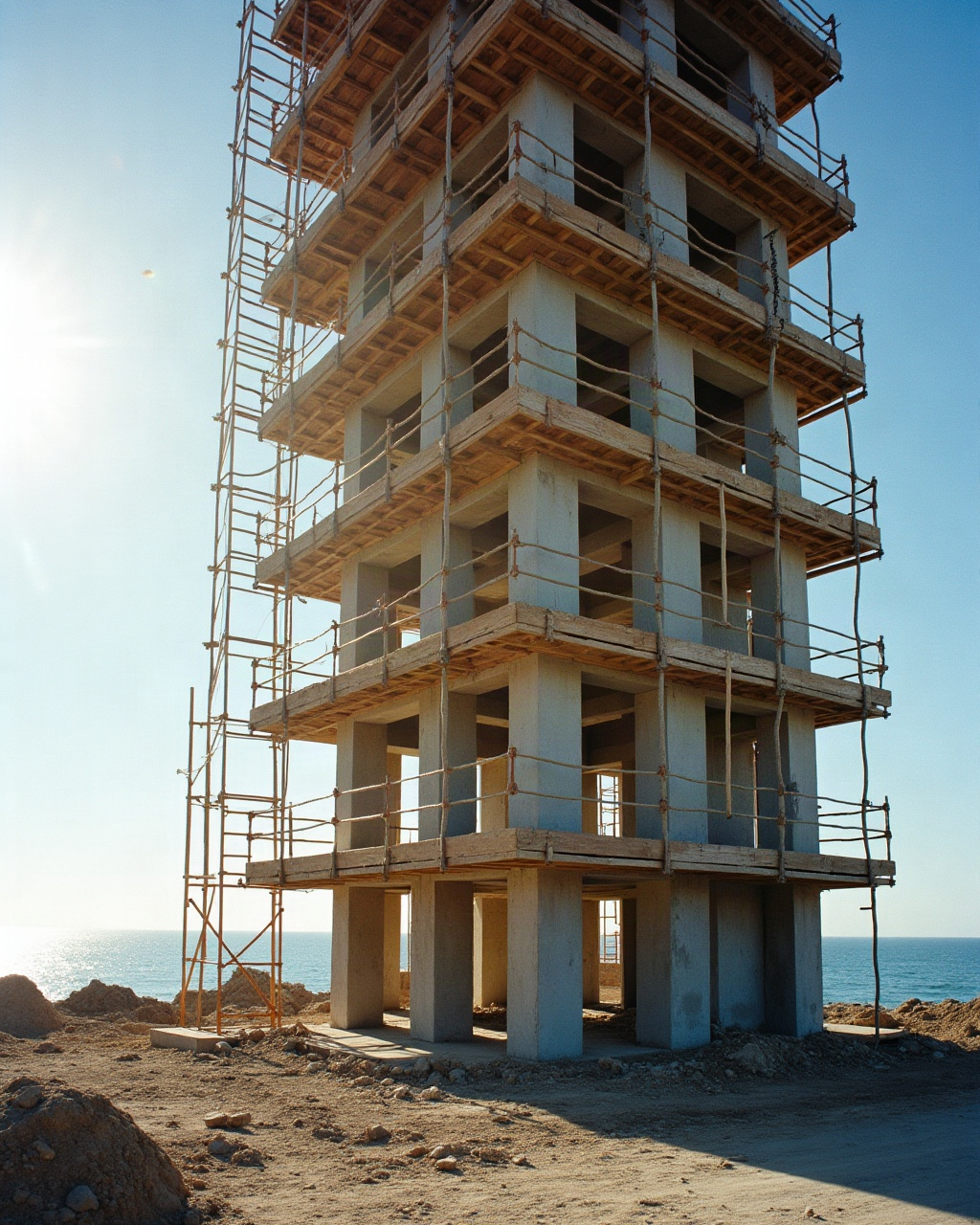
Before it was anything else, a resort casino was a construction schedule: a hotel tower going up storey by storey, a convention hall taking shape beside it, a theatre fitted out while the concrete on the floor above was still curing. The building type that arrived in Australia through the licensing wave of the early 1980s was never a casino with rooms attached to it — it was the reverse. The gaming floor, the tables, the slots or the pokies depending which side of the Pacific you're standing on, sat in the plan as one room among many: a single tenancy inside a larger structure built to be checked into, fed, entertained and put up for the night.
Call the type by its parts and the list runs long before it reaches the gaming floor: a hotel tower with guest rooms stacked above a podium, one or more convention or function halls sized for trade fairs and conferences rather than punters, a theatre or showroom built to a proper fly-tower height, a run of restaurants and bars sized like a small town's entire dining strip, and — usually tucked at podium level, windowless, on its own climate schedule — the room with the tables and the machines. On the floor plan it reads as one wing among several, not as the building's reason for existing.
Two licences, two scales
A licence for a desert town, a licence for a boomtown
The wave that produced this building type in Australia didn't begin in a capital city. Lasseters opened in Alice Springs in 1981, a licensed casino set down in a desert town of only a few thousand people — proof, before the wave went any further, that the model didn't need a capital city under it to work. Four years on it reached something closer to its opposite. Burswood Island Casino opened on the Swan River in Perth on 30 December 1985, and at opening it was the largest casino in Australia, reportedly the third-largest in the world — the same licensing instrument that had underwritten a small desert town's casino now underwriting a complex built at a scale to match a state capital's ambitions for itself.
- 1981
Lasseters, Alice Springs
Licensed for a desert town of a few thousand people — one of the wave's first swings, and its smallest.
- 30 DEC 1985
Burswood Island Casino, Perth
Opened as the largest casino in Australia, reportedly third-largest in the world at the time.
Field study
Wrest Point: the tower that set the template
More than a decade before Lasseters or Burswood there was already a complete working example of the type. Its doors opened on 10 February 1973 above the Sandy Bay shoreline of Hobart: Wrest Point Hotel Casino, the country's first lawful casino, awarded to the state with the smallest population of them all — the least likely audience served first. Roy Grounds, whose hand lies across so much of Australian modernism, drew the tower as an octagon of seventeen storeys reaching 64 metres. No building in Hobart stood taller on opening day, and none has since — a fact that measures the city's restraint in the decades after as much as the tower's ambition.
The octagonal plan wasn't decoration. Eight angled faces instead of four flat ones meant every upper room could be turned slightly toward the water rather than sitting square to it, so a guest floor stacked above the casino still read, room by room, as a building about the view rather than about what happened underneath it. At the top, a revolving restaurant completed the arrangement — the same device fitted to observation towers of the same era, borrowed here for a building whose highest room was also its farthest from the tables downstairs.
Eight sides, one river view repeated eight times over — the tower was built to be looked out of far more than it was ever built to be looked at.
Marginal note
A booking hall that became a casino floor
Not every building in the wave was purpose-built for the job. The Adelaide Casino occupies the 1928 railway station on North Terrace, and its main rooms were designed as a booking hall and a marble concourse for a railway company, not as a gaming floor for anyone. Ticket windows, waiting halls and a concourse built to move commuters through in volume all had to be re-read as spaces for tables and machines, which makes Adelaide the clearest counter-case to Wrest Point's purpose-built tower: proof that the model could be grafted onto an existing civic building as readily as it could be raised from nothing on a riverbank.
Pyrmont: the harbour's turn
Sydney's version of the model arrived on former dockland. The Star opened at Pyrmont, part of a wider redevelopment of the harbour's industrial edge through the 1990s — land that had spent the previous century moving cargo, not guests. The building followed the staged pattern common to the type: a temporary casino trading from 13 September 1995, then the permanent complex opening on 27 November 1997, two years for a working wharf to be turned into a hotel-and-convention tower with a gaming floor as one tenancy among the rest. A coastline learning to host, one redeveloped wharf at a time — the floor was never the whole building, and here least of all.